
Emergency Air Duct Cleaning Near Me: What Edmond Homeowners Should Do First
Calling a duct cleaner the same day water gets into your system is usually the wrong first move, and most people make it. A true duct emergency is defined by an active contamination source, not by how bad the smell or the dust looks. The sequence you follow in the first hours protects your home, your HVAC equipment, and your insurance claim. Skip it and you can turn a manageable problem into a gutted duct system. If you’d rather not sort through it alone, call (844) 461-1541 and we’ll talk you through where you stand before anything gets scheduled.
How Do You Know If It’s a True Duct Emergency or Just an Urgent Cleaning Need?
A true duct emergency has an active contamination source feeding the system right now: standing water in the ducts, an animal still inside the ductwork, fire or smoke residue from a recent event, or hazardous material that blew into the system from a renovation or an accident. An urgent cleaning need is different. It’s accumulated debris, pet hair, or years of dust that’s making the air worse, but nothing new is being added today.
The distinction matters more than it sounds. Here’s how we separate them:
- Water intrusion: a burst pipe, roof leak, or flood that reached the ductwork is an emergency. Damp debris sitting in a sealed metal box is a breeding ground, and mold can establish itself fast on dust that was already there.
- Rodent or pest intrusion: an emergency, because the animal is likely still getting in and leaving waste behind with every visit.
- Smoke or fire residue: an emergency if the HVAC ran during or after a fire, since smoke particles get pulled through the whole system.
- Visible dust blowing from registers, musty odors, increased allergy symptoms: an urgent cleaning need. Uncomfortable, but not a today problem.
One practical test for Edmond homeowners: if you can trace what’s contaminating the system to something that happened in the last few days, treat it as an emergency. If the air quality has just been sliding for a while, it’s an urgent cleaning. Either way, the first call is often to your HVAC technician to shut the system down, not to a cleaner.
What’s the Right Sequence After Water Gets Into Your Ductwork?
Water intrusion is the most common emergency we get called about, and it’s the one where the order of operations matters most. The correct sequence is HVAC shutdown first, then moisture assessment, then a drying window, then cleaning. Cleaning wet ducts before they’re dry is how good ductwork gets ruined and a claim gets complicated.
Here’s the sequence in detail:
- Shut the system down. Turn the HVAC off at the thermostat and at the breaker. Running air through wet ductwork pushes moisture and any contaminants into every room and stresses the blower. This is a hard stop, not a suggestion.
- Assess the moisture. Determine where the water came from, how far it traveled, and whether it reached insulated flex duct or a metal trunk line. Insulated duct that soaked through usually needs replacement, not cleaning.
- Dry before you clean. Get air movers and dehumidification going. Duct interiors need to be genuinely dry before anyone agitates the surface, because a brush or a blower over damp debris just spreads mold spores around. This drying window is where most homeowners get impatient and hire the wrong company.
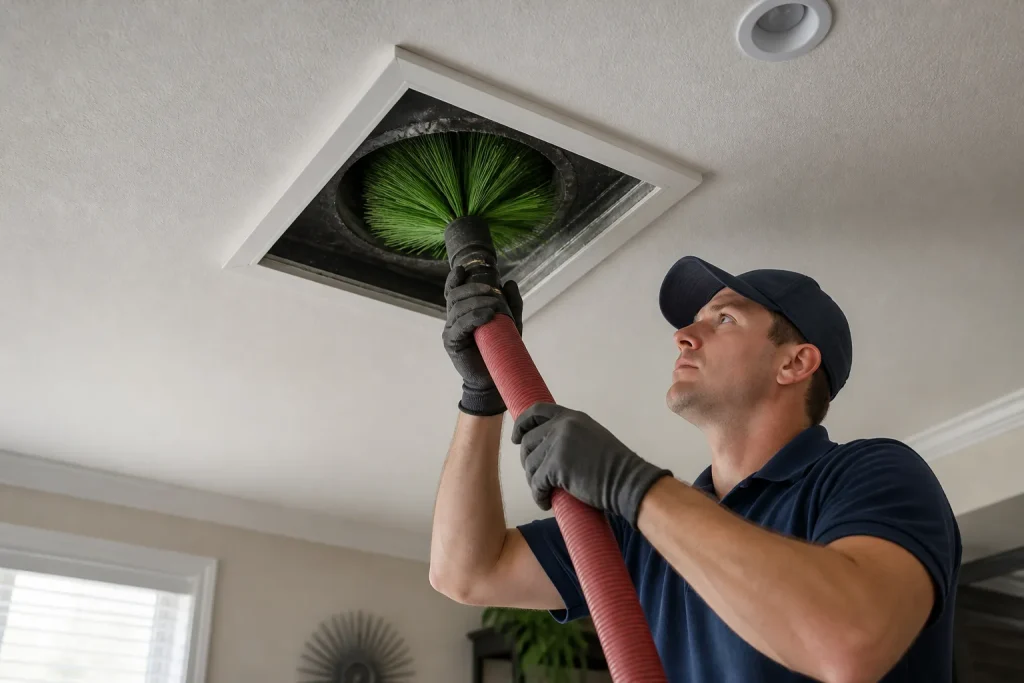
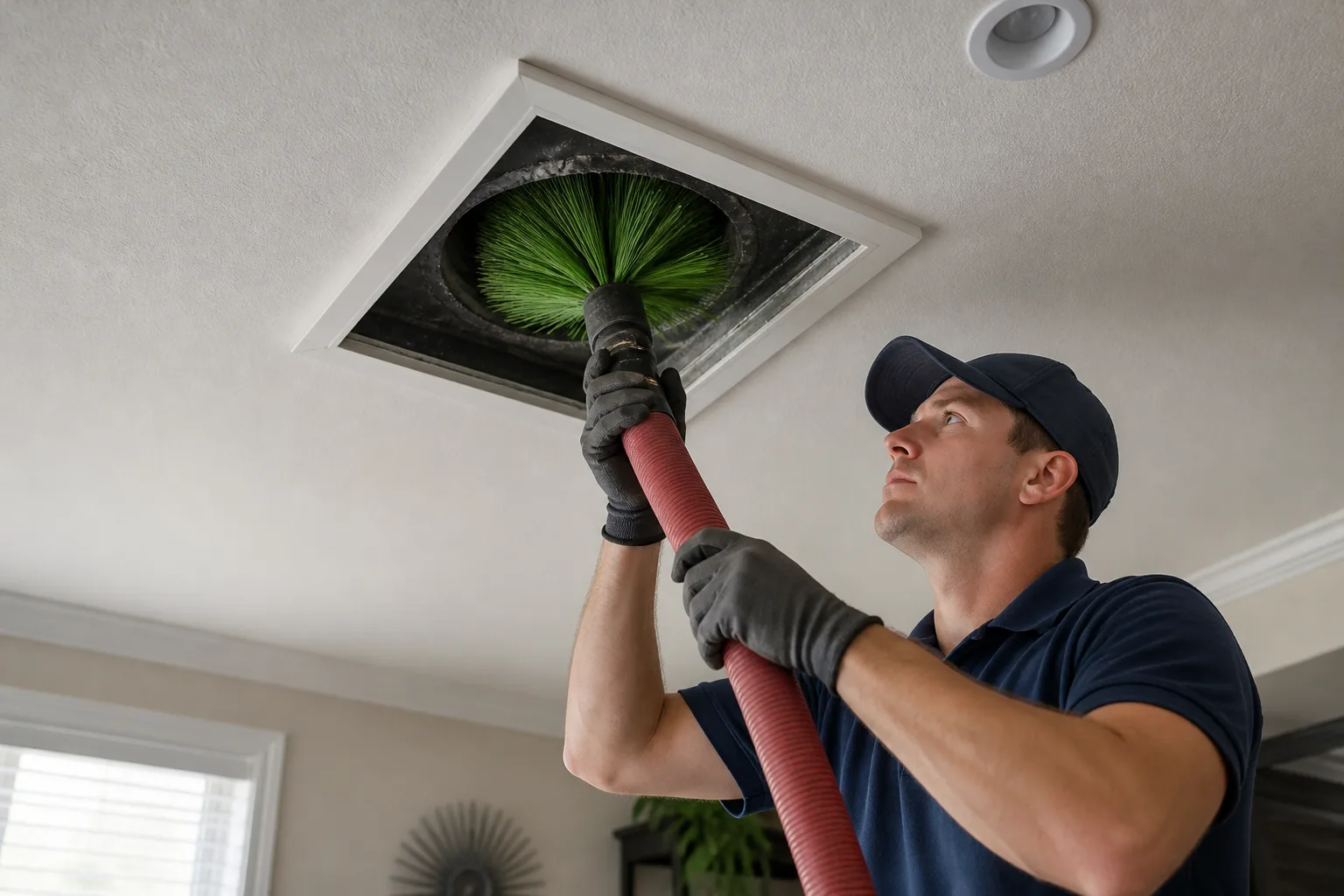
- Clean and sanitize. Once dry, the system can be mechanically agitated and extracted. This is where professional equipment earns its keep: a rotary brush system dislodges the buildup and HEPA-grade extraction pulls it out at the source instead of blowing it into your living room.
- Document the repair. Wet ductwork often tears at seams or loosens connections. Repair what the cleaning exposes so the system is sealed and the problem doesn’t come back.
In our experience, the companies that show up with a shop vac and a leaf blower skip straight to step four. On wet ductwork, that’s the worst possible order.
What Documentation Do You Need Before the Contractor Arrives?
If your emergency is tied to an insurance claim, documentation gathered before anyone touches the system is what protects your reimbursement. Contractors can clean, but only you can capture the state of your home in the first hours. Photos and a written timeline do more for a claim than any invoice will.
- Photos before anything is moved. The water line on walls, the condition of the registers, any visible debris, the thermostat setting when you shut it down.
- A timeline. When the water appeared, when you noticed it, when you shut off the HVAC. A short note on your phone works; write it while it’s fresh.
- Confirmation the system was shut off. A photo of the thermostat or breaker panel is enough. Insurers want to see that the damage was stopped as soon as reasonably possible rather than made worse by continued operation.
- Any receipts or documentation of the source event (plumber’s report, restoration company’s assessment, so on). Keep them together.
- Ask the cleaning company for before-and-after photos of your own ducts. That’s a reasonable request for any contractor in Edmond, and it gives your insurer a clean record of condition before and after.
Ask the company to document the same way you did. A contractor who photographs the system before and after is also the one who can tell you honestly whether what they found was pre-existing or caused by the event. That distinction usually decides the claim.
What’s the Protocol for Rodent Intrusion in Edmond Ductwork?
Rodent intrusion follows a different sequence than water: exclusion first, sanitation second, cleaning third. Cleaning a system without first sealing the entry point leaves you with a clean duct and a rodent that walks back in. It’s one of the most common repeat visits we deal with.
- Find and seal the entry point. This means a pest control professional identifies how the animal is getting in and closes it. Until that’s done, cleaning is a temporary fix at best.
- Remove the animal and waste. Trapping and removal comes before sanitation, not after.
- Sanitize, then clean. Rodent waste carries disease risk, so the surfaces get treated before the mechanical cleaning pulls debris into the air. This is where containment-grade tools matter: negative pressure during the cleaning keeps contaminants from migrating into your living space.
- Seal and repair compromised ductwork. Rodents chew through flex duct and insulation. Any tearing gets repaired, not just cleaned over.
What most people miss is that a cleaning without exclusion leaves you with a system that’s cleaner today and contaminated again within days. We repair what we find, because on a rodent job the repair and the exclusion are as important as the clean itself.
What Questions Should You Ask an Emergency Duct Cleaning Company?
Ask how they handle wet ductwork, how they confirm exclusion on a rodent job, and what equipment they actually use on site. The answers separate a restoration-aware company from a coupon operation, and in Edmond the difference is usually obvious in three minutes on the phone.
Our short list of questions worth asking:
- “If my ducts are wet, will you clean them before they’re dry?” The answer is no, always. A company that says otherwise doesn’t understand what it’s doing.
- “What equipment do you run?” Listen for named professional equipment: rotary brush systems, HEPA-grade extraction, containment-grade negative pressure. If they can’t name their tools, they don’t have much.
- “Do you offer duct repair, or just cleaning?” If they can’t repair what they find, you end up with two contractors and one missing set of records.
- “How will you document the condition before and after?” Photos of your own system, before they touch it.
- “How do you handle containment on a contaminated job?” The right answer involves keeping the debris under control while it’s removed, not just blowing it around.
On the equipment side, we run Rotobrush rotary brush systems that mechanically dislodge buildup rather than relying solely on air pressure, Nikro HEPA-grade extraction that captures dislodged debris at the source, and Abatement Technologies containment tools that hold negative pressure during cleaning. We’re also authorized to install and service Honeywell and Aprilaire air quality systems, so the filtration you use to keep your air clean after the clean can be part of the same conversation. Dryer vents are worth including in the same visit: those are a fire risk, not a maintenance item, and it’s a job we handle alongside air duct cleaning. If your ducts need repair after a contamination event, we handle that too.
Related services in Edmond
If you’re sorting out a duct emergency in Edmond, the work often pairs with dryer vent cleaning to clear the second source of hidden fire risk while we’re on site, and it all sits under the same standard of care we bring to every duct cleaning job in Edmond. We also offer Duct Cleaning Edmond-area estimates free of charge, and our technicians have up to 13 years of experience handling exactly this kind of sequencing.
The Bottom Line
The first hour of a duct emergency is about stopping the source, documenting what happened, and drying before you clean. Do those three things and the contamination stays contained, your insurer has what they need, and the cleaning actually works. Skip the sequence and you pay twice: once for a bad clean and once for the repair it caused.
Key takeaways to keep in mind:
- True duct emergencies have an active contamination source; accumulated debris is an urgent cleaning, not an emergency.
- Water in the ducts means HVAC off, assess moisture, dry, then clean. Never clean wet ductwork.
- Document before anyone touches the system: photos, a timeline, confirmation the system was shut down.
- Rodent intrusion needs exclusion first, sanitation second, cleaning third.
- Ask any contractor what equipment they run and whether they can repair what they find.
If you’re in Edmond and need help, Duct Cleaning Edmond offers free estimates. Call (844) 461-1541. We answer 24/7, and fast dispatch runs 7am to 7pm, Sunday through Friday. One important note before you schedule: we don’t dispatch crews on Saturday, so if a door fails or the system goes down on a Saturday, call us and we’ll book you into the next opening on Sunday. We work only on ducts we can document with before-and-after photos, and we repair what we find rather than walking away from a leaking or damaged system.
Frequently Asked Questions
It depends on the scope: whether the system needs drying, whether insulation needs replacement, and whether duct repair is part of the job. We set one flat price per system after we look at it, and the written estimate sets the final price. We don’t quote per-vent prices and we don’t lead with a coupon number that changes once we’re on site. Call (844) 461-1541 for an exact quote; estimates are free.
Because those quotes usually skip steps: no drying window, no containment, no exclusion on a rodent job, no repair. A shop vac or a leaf blower costs a fraction of a rotary brush system and HEPA extraction, and the labor is a fraction too. The cheaper job often leaves the problem in place, or spreads it. Ask what equipment they run and whether they dry before cleaning, and the difference in price usually makes sense. Call (844) 461-1541 if you want to talk through a quote you’ve already received.
Ask for before-and-after photos of your own ducts. That’s the simplest check available, and a contractor doing a real job should have no trouble providing them. We photograph the system before and after on every contaminated job. If a company won’t show you what they did, that tells you something. Call (844) 461-1541 and we’ll walk you through what a real documentation set looks like.
Most homes don’t need it on a fixed schedule. Clean when the system tells you: visible dust blowing from registers, musty odors, a recent renovation, a contamination event, or a new pet in the house. An emergency is different from routine maintenance, and in Edmond we’d rather clear both questions in one conversation. Call (844) 461-1541 and we’ll give you a straight answer on whether you need cleaning now or can wait.
Written by the team at Duct Cleaning Edmond.
Need Air Duct Cleaning Help?
Call Duct Cleaning Edmond - licensed & insured, with free written estimates in Edmond.
(844) 461-1541