
Nikro Air Duct Cleaning in Edmond: A Homeowner’s Guide
A shop vac generates enough airflow to move dust, but it exhausts that same air right back into your living space. HEPA extraction captures it instead. Those two approaches are not equivalent, and the price gap between a low bid and a real duct cleaning in Edmond often comes down to exactly this difference. If your system is due and you’d rather not gamble on the wrong operator, call (844) 461-1541 – estimates are free.
What Nikro HEPA Extraction Actually Is
Nikro builds HEPA-grade vacuum units for professional indoor air quality work. The key word is HEPA: high-efficiency particulate air filtration, which traps the fine particles a standard filter lets pass. A true HEPA unit pulls air through a staged filter stack and captures debris at the source rather than pushing it around. That’s the whole point of the equipment.
The stages work in sequence. Coarse material drops out first, then finer particulate gets caught in progressively tighter media, and the HEPA stage holds the sub-micron particles – the dust, dander and renovation grit that stay airborne longest and reach deepest into your lungs. Standard residential filters miss much of that fraction. A Nikro unit running at its rated airflow holds it instead of returning it to the room.
Airflow matters too. The unit needs enough CFM (cubic feet per minute) to keep meaningful suction at the end of a long duct run. Too little and you’re just nudging dust; the extractor has to pull against the resistance of a whole trunk-and-branch system. That’s why the equipment on the job matters more than the coupon on the flyer.
Negative Pressure vs. Blowing: The Mechanical Difference
Negative-pressure extraction pulls contaminants out of the system and into a sealed collection unit. Positive-pressure blowing pushes air into the ductwork and can drive debris further in – or straight into your rooms. The two methods sound alike in a sales pitch and behave nothing alike in your house.
Here’s the practical distinction:
- Extraction (negative pressure): the extractor creates a pressure differential that draws debris toward the collection point, away from the living space.
- Air-only cleaning: compressed air or a blower agitates dust and relies on suction that may or may not keep up. Fine particulate can escape into rooms.
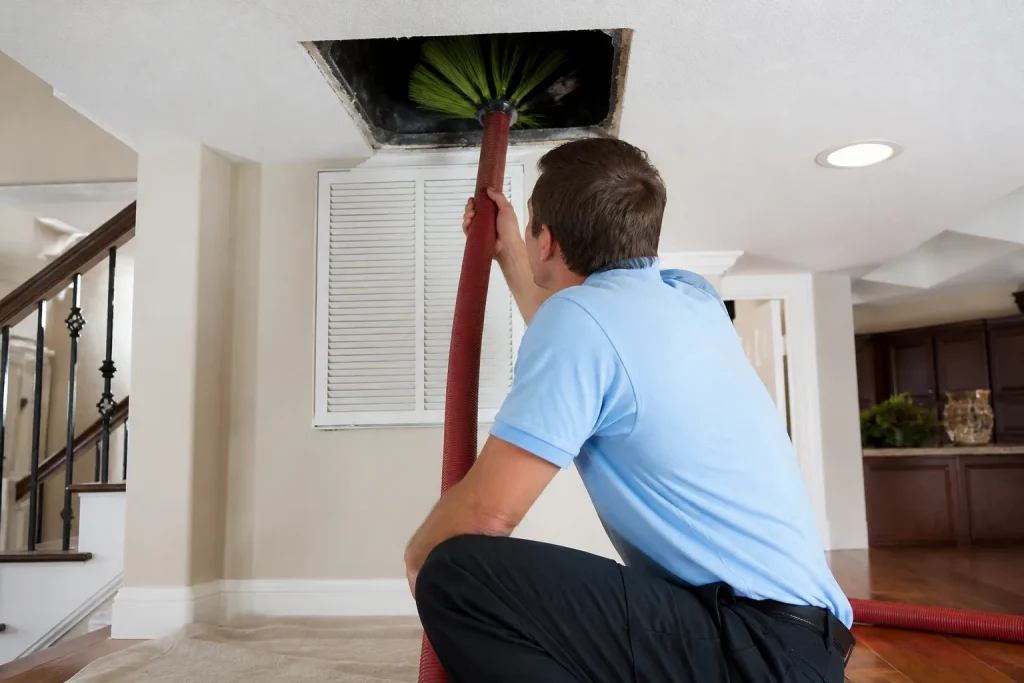
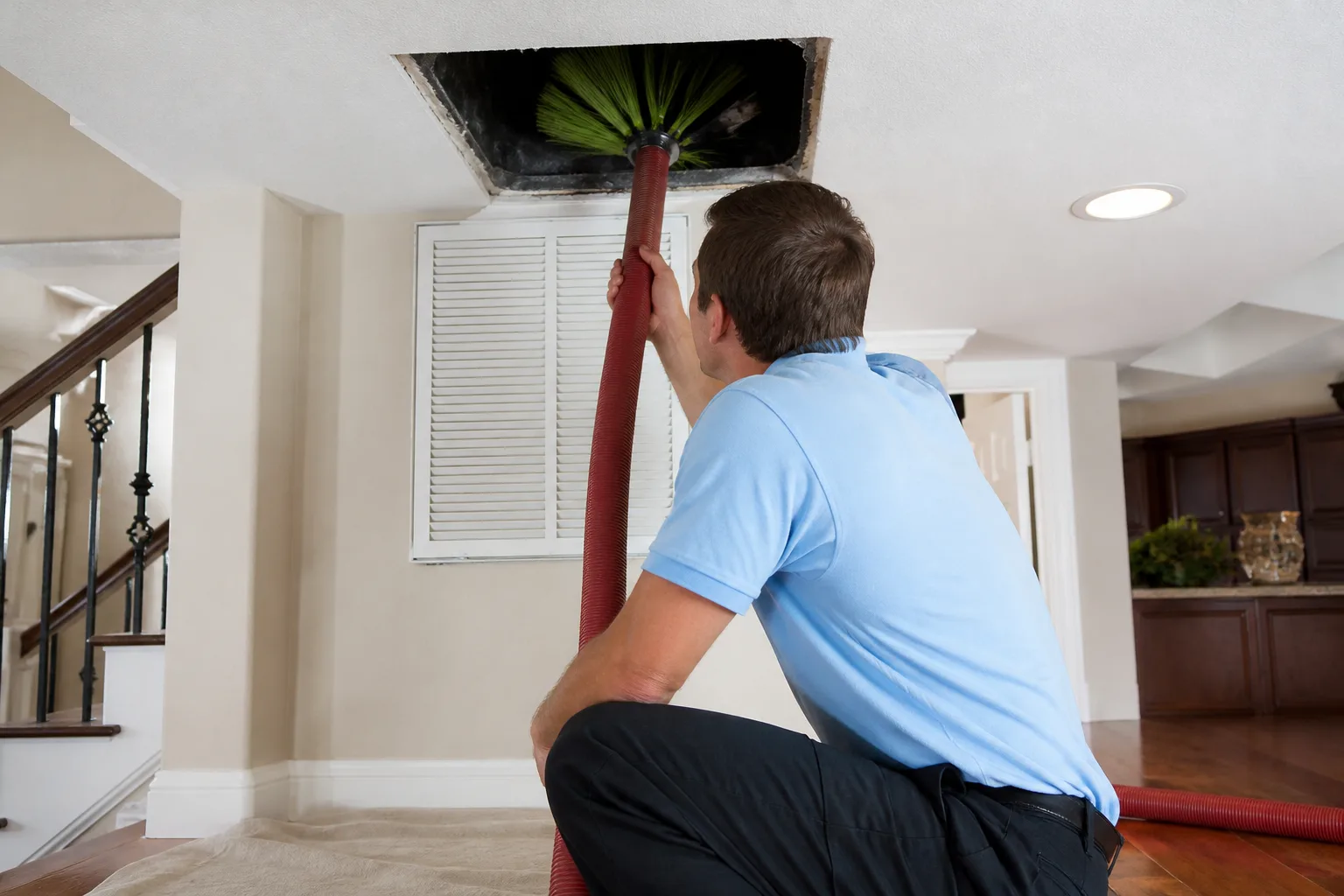
- Mechanical agitation plus extraction: a rotary brush physically breaks buildup off the duct walls while the extractor captures it. This is the combination we rely on with our Rotobrush brush system paired with Nikro extraction.
In our experience, the brush-then-capture sequence is what separates a real cleaning from a blow-and-go visit. Mechanical agitation dislodges what clinging air pressure alone leaves behind. Extraction then removes it under containment. For a closer look at how that plays out on a whole house, see our air duct cleaning service page.
What “Containment” Means During a Cleaning Job
Containment means keeping dislodged debris from escaping into the parts of the home you’re still living in while the work happens. It uses negative pressure and physical barriers to isolate the work zone, so dust crosses from duct to extractor without passing through your kitchen. Abatement Technologies builds containment-grade equipment for exactly this – the same category of tooling used in professional indoor air quality remediation.
Without containment, a cleaning can cross-contaminate duct zones: debris pulled from the return side can drift into supply branches that were already clean, or escape an open register into the room. Containment tools seal the work area and hold negative pressure so that flow stays one-directional. It’s the difference between a job done and a job done safely.
For an older Edmond home, that matters. Plenty of the housing stock around here was built decades ago, and ductwork that age often has seams, joints and loose connections that let debris travel between zones. Contained extraction keeps the process orderly when the ducts themselves are less than airtight.
Agitation, Capture, Repair: How a Real Job Runs
A proper duct cleaning is a sequence, not a single pass. The order matters as much as the equipment. Mechanically agitate, capture under containment, then inspect for damage that cleaning alone won’t fix. We repair what we find rather than cleaning around a problem and leaving.
- Assess: check the system layout, register count and any obvious gaps or disconnected runs.
- Contain: set up negative pressure so the work zone stays sealed.
- Agitate: the rotary brush breaks buildup off duct walls mechanically.
- Extract: Nikro HEPA extraction pulls the debris into a sealed collection unit.
- Inspect: look for compromised ductwork – leaks, torn flex, separated joints – that a cleaning can’t resolve.
- Repair or recommend: fix what’s fixable in the same visit relationship, or lay out what needs attention.
Cleaning a leaking system and walking away just means the dust comes back faster. That’s why we treat air duct repair as part of the job, not an upsell tacked on at the end. If you’re curious how this fits a typical Edmond home, our overview of Edmond covers the local picture.
How to Verify a Contractor Is Really Using HEPA Extraction
You don’t have to take any contractor’s word for it. Ask directly, and listen for specifics rather than reassurance. A real answer names the equipment, explains the method, and holds up to follow-up questions. A vague answer tells you plenty.
Questions worth asking before you book:
- “What extraction unit will you use?” A professional should be able to name their HEPA vacuum and explain its filtration. “We use a powerful vacuum” is not an answer.
- “How do you agitate the ducts?” Listen for a rotary brush or mechanical tool, not just compressed air.
- “How do you contain the debris?” Negative pressure and containment equipment should come up.
- “Can you show me the equipment?” A contractor confident in their stack won’t dodge this.
- “What do you do if you find damaged ductwork?” A cleaner who only cleans will say so. One who repairs will explain how.
Equipment transparency is a credibility signal. When a company is willing to talk about the actual machines and how they work, they’re usually not hiding behind a low price. For more on picking an operator, see our guide to duct cleaning in Edmond.
Why HEPA Extraction Matters More in Some Edmond Homes
Some houses need contained extraction more than others. If anyone in the home has allergies or respiratory concerns, fine particulate is the enemy, and returning it to the air defeats the purpose of cleaning. Homes with older construction often have ductwork that’s accumulated buildup over many years. And a recent renovation is its own category – drywall dust, sawdust and insulation fibers settle into the system and need to be captured, not just stirred up.
Nikro HEPA extraction is built for exactly these cases because it holds the fine fraction rather than recirculating it. Beyond the clean itself, we’re authorized to install and service Honeywell and Aprilaire air quality systems, so filtration and purification can pick up where the duct clean leaves off. That’s a far more effective combination than cleaning a system and then pushing air through a filter that can’t keep up.
We also handle dryer vent cleaning, because a clogged dryer vent is a fire risk, not just a maintenance item – one worth taking seriously in any home.
When to call a pro
If you’re seeing visible dust blowing from registers after a clean, noticing musty odors when the system kicks on, or you’ve just finished a renovation, that’s your cue. Contained HEPA extraction is not a DIY job – the equipment is what makes it work, and a shop vac in the hands of a homeowner can’t replicate it. Call (844) 461-1541. We answer 24/7. Fast dispatch from 7am to 7pm, Sunday through Friday.
The Bottom Line
Nikro HEPA extraction is a real, specific tool that captures fine particulate at the source instead of blowing it back into your rooms. The mechanical sequence – agitate with a brush, capture under containment, then inspect and repair – is what separates a thorough job from a cheap one. If you’re in Edmond and want the equipment explained before anyone touches your ducts, that’s a fair question, and we’re glad to answer it.
If you’re in Edmond and need help, Duct Cleaning Edmond offers free estimates – call (844) 461-1541. You get a flat price per system agreed before work starts and before-and-after photos of your own ducts, so you can see exactly what came out and what went back in.
Frequently Asked Questions
Yes, for duct cleaning it’s a different class of tool. A shop vac moves air but exhausts fine particulate back into the room, while a Nikro HEPA unit captures that fraction through staged filtration. Standard residential filters miss much of what a true HEPA stage holds. Call (844) 461-1541 for an exact quote – estimates are free.
Ask for before-and-after photos of your own ducts, and have the contractor walk you through what the extraction captured. A contained HEPA job produces visible evidence, and you should be able to see it. If a company can’t show you, that’s your answer. Call (844) 461-1541 to schedule a free estimate.
Most homes benefit every few years, but it depends on your situation – recent renovations, pets, allergy sufferers, or older ductwork often call for it sooner. There’s no single schedule that fits every Edmond house. Call (844) 461-1541 and we’ll talk through what your system actually needs.
Because the equipment and the process are different. A low quote often means air-only blowing with little containment, not brush agitation plus HEPA extraction. You’re comparing two different jobs, not two prices for the same one. Call (844) 461-1541 for an honest estimate based on a whole-system flat price.
Written by the team at Duct Cleaning Edmond.
Need Air Duct Cleaning Help?
Call Duct Cleaning Edmond - licensed & insured, with free written estimates in Edmond.
(844) 461-1541